Open Shift Coverage Guide: How to Stop Costly Callout Chaos
Open shift coverage guide: how to stop costly callout chaos.
Use this open shift coverage guide to identify the real staffing gap, find eligible employees, check availability and schedule risk, route the opportunity, approve the best-fit response, and confirm the shift without creating a second operational problem.
How do you fill an open shift?
Start by confirming exactly what coverage is missing. Define the qualifications and location requirements, identify employees who are eligible and available, review overtime and schedule conflicts, send the opportunity through a controlled process, compare responses, and then update the schedule and notify everyone affected.
Open shift coverage process
Jump to the part of the workflow you need.
Open shift coverage is a decision workflow, not just an announcement.
An open shift exists whenever the published schedule no longer has the employee coverage required for the work. The gap may come from a callout, approved time off, turnover, a demand increase, a late schedule change, a training requirement, or a shift that was never assigned.
The fastest response is often to message everyone and wait for someone to say yes. That can work, but it can also create overlapping shifts, avoidable overtime, minimum-rest problems, qualification gaps, unfair distribution, duplicate claims, and confusion about who is actually responsible for showing up.
The goal is to place the right eligible employee into the shift, with enough context for the manager to approve the decision and enough communication for the team to treat the updated schedule as final.
A practical open shift coverage guide for managers.
The same basic sequence works for planned open shifts, short-notice coverage requests, and urgent employee callouts. The amount of time available may change, but the decision checks should remain consistent.
Confirm the real coverage gap.
Before contacting employees, confirm what is actually uncovered. A callout does not always mean the full shift must be replaced exactly as written. The team may need one qualified employee for the entire shift, partial coverage during peak hours, a different job assignment, or a manager-approved reduction in staffing.
- Confirm the date, start time, end time, and location.
- Identify the team, job, position, certification, or qualification involved.
- Determine the required headcount and the operational impact of leaving the shift open.
- Check whether the work can be reassigned, shortened, split, or delayed safely.
- Set the response deadline based on urgency.
Managers sometimes start outreach before checking whether another schedule change already solved the gap. That creates unnecessary messages and competing claims.
Define who is actually eligible to work the shift.
Eligibility should be established before the opportunity is offered. This prevents employees from volunteering for work they are not allowed, trained, qualified, or assigned to perform.
- Required job or role
- Location, site, branch, or team access
- Licenses, certifications, training, or customer-specific requirements
- Manager approval requirements
- Any restrictions created by time off, leave, onboarding status, or inactive assignments
A broad message may appear faster, but targeted outreach is more efficient when only a subset of employees can legitimately cover the work.
Identify employees who are available and schedule-compatible.
Availability is one part of eligibility, not the entire decision. An employee may be willing to work but already scheduled elsewhere, approved for time off, unavailable during part of the shift, assigned to another location, or unable to meet travel requirements.
- Review recurring and date-specific availability.
- Check the employee’s current shifts before and after the open shift.
- Confirm approved time off or leave.
- Review location and team assignments.
- Consider employee preferences and equitable access to extra hours where appropriate.
The result should be a realistic candidate pool rather than a list of every employee in the organization.
Evaluate overtime, overlap, rest, and policy risk.
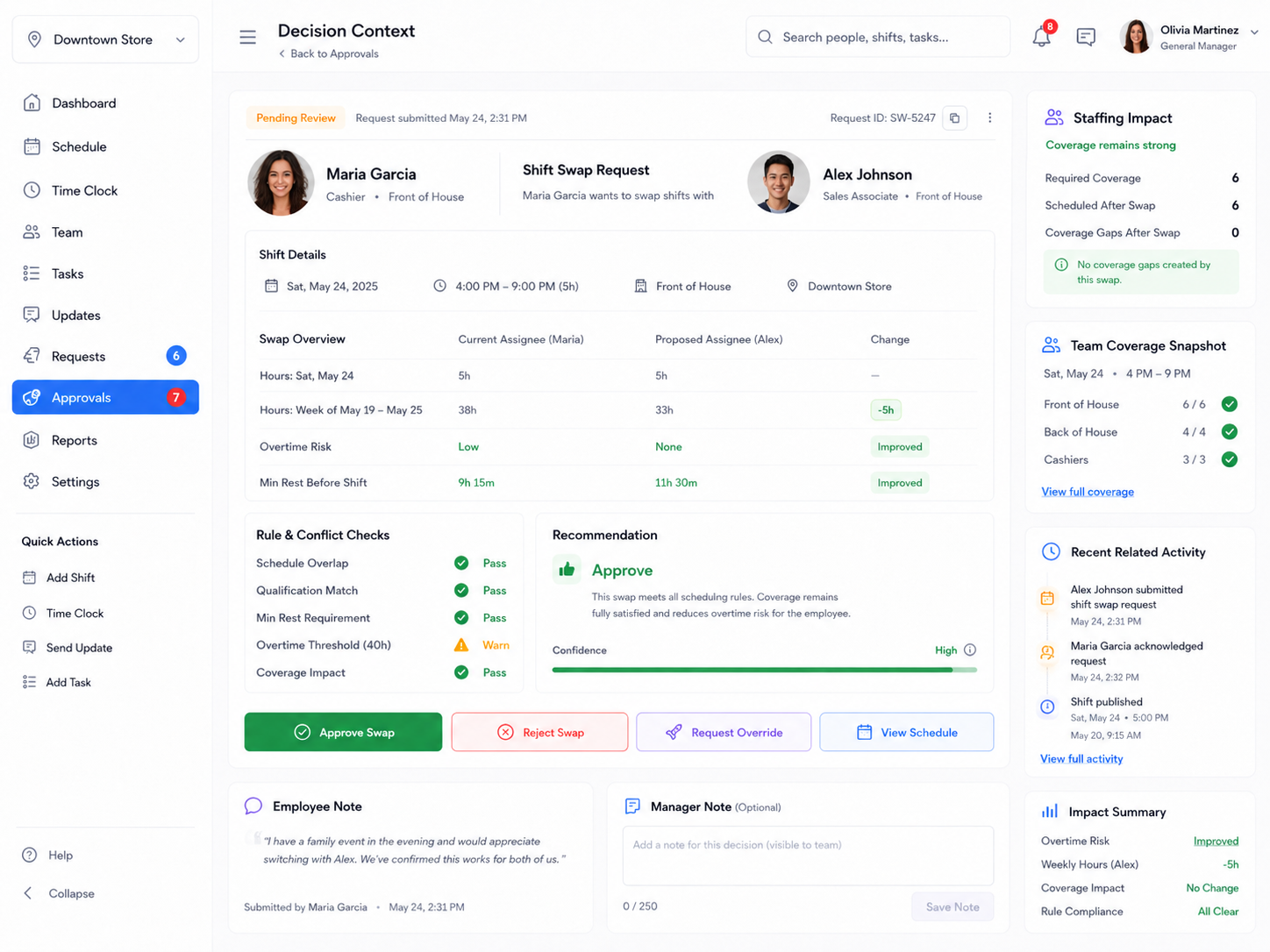
Coverage can solve an immediate staffing problem while quietly creating a payroll, fatigue, or compliance problem later. This open shift coverage guide helps managers compare each candidate against the full schedule before approval and evaluate overtime exposure before assigning the replacement employee.
- Projected daily and weekly hours
- Overlapping assigned shifts
- Minimum rest between the prior shift and the open shift
- Minimum rest before the employee’s next scheduled shift
- Consecutive days or organization-specific scheduling limits
- Travel time or location fit
- Warnings that may be approved versus rules that should block the assignment
A warning does not always mean the employee cannot cover the shift. It means the manager needs enough context to decide whether the tradeoff is acceptable and whether an override requires a documented reason.
For federal overtime basics, review the U.S. Department of Labor overtime guidance. State and local requirements may provide additional protections, so employers should apply the rules that govern their workforce.
Send the opportunity through a controlled process.
Once the eligible audience is clear, send the shift with the information employees need to make a real decision. Include the date, time, location, job, expected responsibilities, response deadline, and whether manager approval is required.
- Use targeted offers when only specific employees qualify.
- Use an open-shift marketplace when multiple eligible employees may claim the opportunity.
- Set an expiration or response window so stale requests do not remain open.
- Avoid sending duplicate messages through several channels unless escalation is necessary.
- Make it clear that volunteering is not final assignment until the workflow confirms it.
Structured coverage requests reduce the chance that two employees believe they accepted the same shift or that a manager approves someone after another person has already been assigned.
Review responses and approve the best-fit option.
The best response is not always the first response. Compare the employees who volunteered or claimed the shift using the same decision criteria you established earlier.
- Qualification and assignment eligibility
- Availability and current schedule
- Overtime and labor-cost impact
- Overlap and rest risk
- Urgency and operational fit
- Fairness and distribution of extra hours
- Any required manager explanation or override reason
Where policy permits automatic approval, the system should approve only when the assignment meets the organization’s configured rules. Exceptions should route to a manager instead of disappearing into a silent automated decision.
Update the schedule and close the communication loop.
A shift is not covered merely because someone said yes. The authoritative schedule must be updated, competing requests must be closed, and the affected employees and managers must receive confirmation.
- Assign the approved employee to the shift.
- Remove or resolve the original uncovered status.
- Close competing claims, offers, or pending requests.
- Notify the approved employee and the employee being replaced.
- Notify the responsible manager or location lead.
- Record the decision and any override reason.
- Confirm that downstream tasks, notes, and responsibilities follow the new assignment.
This final step prevents the most damaging failure in a coverage workflow: everyone assuming someone else updated the schedule.
How to handle a last-minute employee callout.
A same-day callout compresses the timeline, but it should not eliminate the essential checks. Use a shorter decision window and a clear escalation path rather than skipping eligibility, schedule risk, approval, or confirmation.
Same-day callout workflow
- Confirm when the employee called out and whether any part of the shift can still be worked.
- Identify the minimum viable coverage needed for the remaining workload.
- Filter immediately to employees who are qualified, reachable, available, and close enough to report on time.
- Check overtime, overlap, rest, and next-shift risk before outreach where possible.
- Send the opportunity with a short response deadline and a clear approval status.
- Escalate to a manager if no qualified candidate responds.
- Confirm the assignment in the schedule and notify the team before treating the shift as covered.
When no safe or eligible employee is available, the fallback decision may be to redistribute work, reduce service, reassign a manager, modify operating hours, or document the uncovered shift. A rushed unsafe assignment is not automatically better than an acknowledged staffing gap.
Open shift coverage decision checklist.
Use this open shift coverage guide checklist before approving a replacement employee.
| Decision area | Question to answer | Evidence to review |
|---|---|---|
| Coverage need | What work and headcount are truly uncovered? | Published schedule, demand, shift notes, manager context |
| Eligibility | Is the employee allowed and qualified to perform the work? | Job, team, location, training, certification, assignment status |
| Availability | Can the employee work the entire required period? | Recurring availability, date exceptions, time off, commitments |
| Schedule fit | Does the shift conflict with any current assignment? | Prior, overlapping, and next shifts |
| Labor impact | What regular and overtime hours will the assignment create? | Daily and weekly projected hours |
| Rest and fatigue | Is there enough rest before and after the shift? | Minimum-rest rule and adjacent shifts |
| Approval | Can this assignment be automatic, or does a manager need to decide? | Organization policies, warnings, blocks, override requirements |
| Communication | Does everyone understand the current status? | Request state, response deadline, manager messages |
| Confirmation | Is the schedule updated and are competing requests closed? | Final assignment, notifications, decision history |
Common open shift coverage mistakes.
Offering the shift to everyone
Broad outreach creates noise when only a small number of employees are actually qualified, available, and schedule-compatible.
Choosing the first response automatically
Fastest does not always mean qualified, lower-risk, or operationally appropriate.
Checking overtime after approval
Managers should see projected labor impact before the schedule is changed, not after payroll review.
Ignoring adjacent shifts
A replacement may fit the open time while violating overlap or minimum-rest expectations around another assignment.
Leaving stale requests open
Old claims and offers create confusion about whether the shift is still available or already assigned.
Failing to confirm the final schedule
A verbal yes, text reply, or claim is not a reliable final state unless the schedule and notifications are updated.
How Shiftaro supports open shift coverage.
Shiftaro is designed to connect the full decision—from the original staffing gap through employee eligibility, schedule context, response, manager approval, final assignment, communication, and history.
Instead of asking managers to compare separate spreadsheets, texts, scheduling screens, and approval messages, Shiftaro brings the relevant context into one workflow. Managers can evaluate qualifications, availability, existing shifts, overtime exposure, overlap, minimum rest, and policy warnings before approving coverage.
Employees can see relevant open shifts or receive direct offers without assuming that a claim automatically changes the schedule. Approved coverage updates the authoritative assignment, closes competing requests, and gives managers and employees a clear final state.
Open shift coverage questions.
What is open shift coverage?
An open shift coverage guide explains the process of identifying an uncovered shift, finding employees who are eligible and available, evaluating schedule and labor risk, approving a replacement, updating the schedule, and notifying everyone affected.
How do you fill an open shift quickly?
Confirm the exact staffing need, filter to qualified and available employees, review overtime and schedule conflicts, send a structured opportunity with a response deadline, approve the best-fit response, and immediately update the schedule and notifications.
Who should be offered an open shift?
Offer the shift to employees who meet the job, team, location, training, and qualification requirements and whose availability and existing schedule allow them to work without unacceptable overlap, rest, or overtime risk.
Can employees claim open shifts themselves?
Yes, when the organization allows it. A claim may be automatically approved when all configured rules are satisfied or routed to a manager when qualifications, overtime, overlap, rest, or other exceptions require review.
How can managers avoid overtime when filling open shifts?
Review each candidate’s projected daily and weekly hours before approval. Compare employees who can cover the shift without pushing avoidable hours into overtime and document the reason when overtime is the best available option.
What happens after an employee accepts an open shift?
The acceptance should be validated, approved when required, added to the authoritative schedule, communicated to the affected employees and manager, and used to close competing requests or claims.
Move from open shift to confirmed coverage with better context.
Connect scheduling, qualified coverage, availability, risk checks, approvals, communication, and final assignment in one workforce operations workflow.
Explore coverage managementBook a demo